
 EN
EN
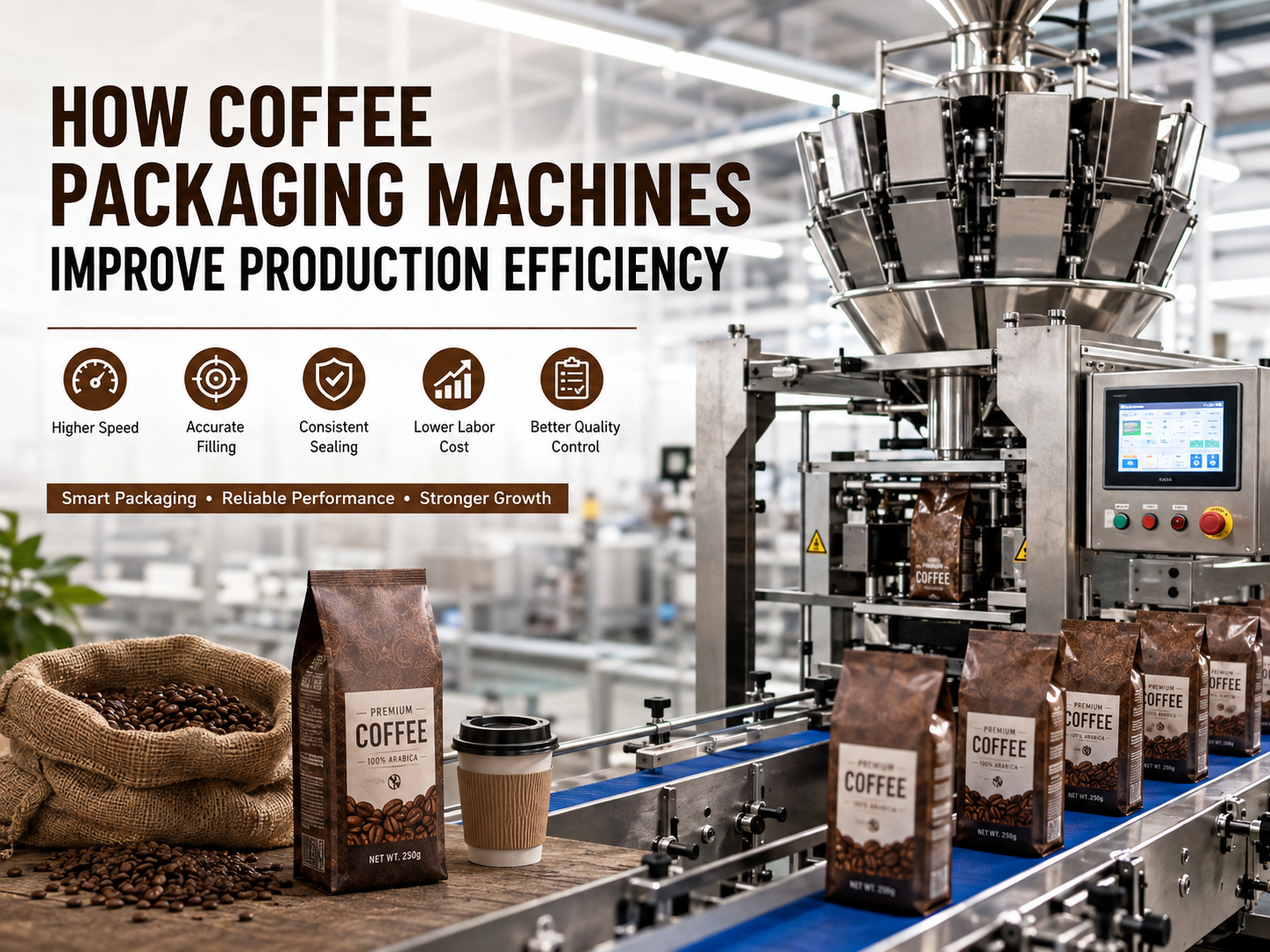
How Coffee Packaging Machines Improve Production Efficiency
Coffee packaging is one of those parts of production that can look simple from the outside. Fill the bag, seal it, put a label on it, and move on.
In a real coffee factory, it is rarely that straightforward.
As order volumes increase, packaging can quickly become the bottleneck. Roasting capacity may be sufficient, but finished coffee starts piling up because filling is slow. Operators spend hours weighing beans by hand. Different employees produce slightly different fill weights. Sealing quality varies. Switching from a 250 g bag to a 500 g bag takes longer than expected.
This is where a well-designed coffee packaging machine can make a measurable difference.
The goal of automation is not simply to make a machine run faster. Good packaging automation should make the entire process more stable: accurate filling, consistent sealing, fewer manual steps, lower waste, easier production planning, and better use of labor.
For coffee roasters and manufacturers considering an investment, this guide looks at what actually affects coffee packaging machine efficiency, from equipment selection and packaging materials to customization, MOQ, lead time, certification, and long-term operating costs.
What Is a Coffee Packaging Machine?
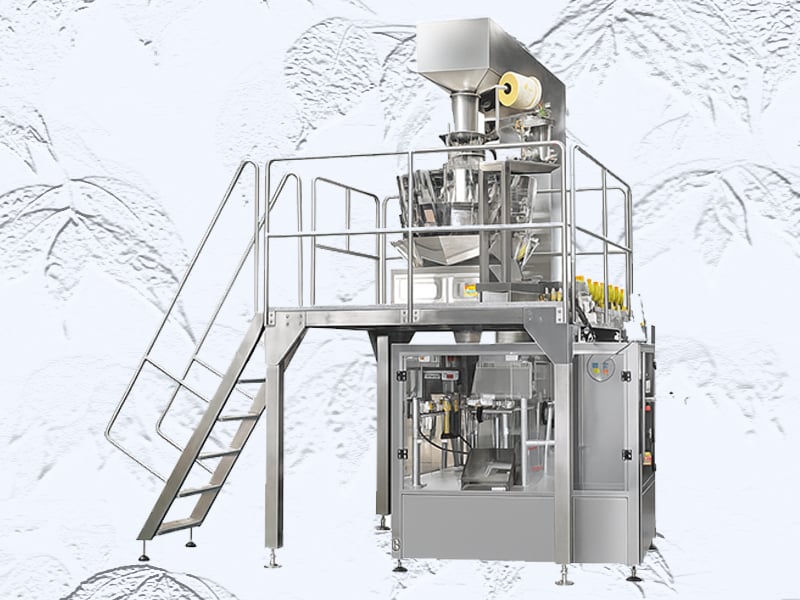
A coffee packaging machine is equipment designed to automate some or most of the steps involved in packing coffee.
Depending on the product and production volume, a system may handle:
-
Coffee weighing
-
Coffee filling
-
Bag opening
-
Bag positioning
-
Nitrogen flushing
-
Heat sealing
-
Date and batch coding
-
Checkweighing
-
Metal detection
-
Finished-bag collection
The configuration depends heavily on the type of coffee being packaged.
A company producing 250 g whole-bean coffee in stand-up pouches has very different requirements from a manufacturer producing single-serve drip coffee bags.
For a conventional coffee pouch, a typical process might look like:
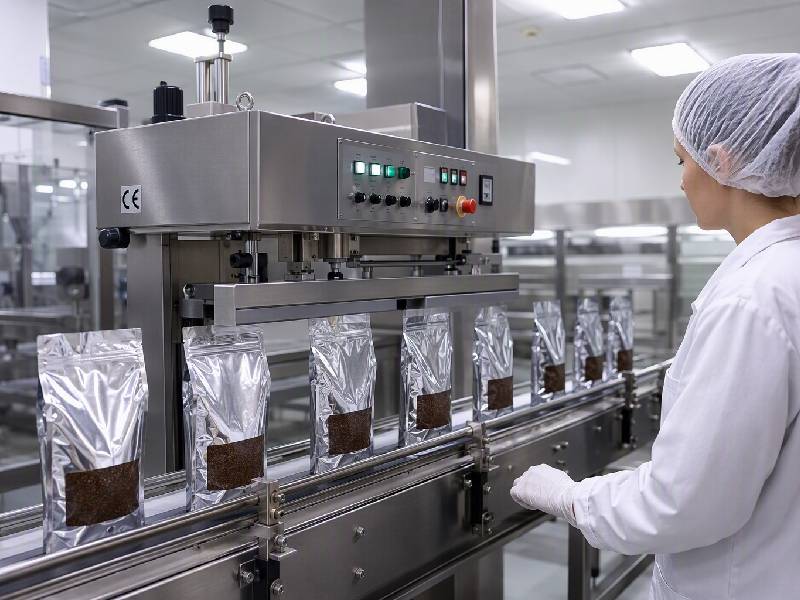
Coffee feeding → Weighing → Filling → Nitrogen flushing → Sealing → Coding → Inspection → Collection
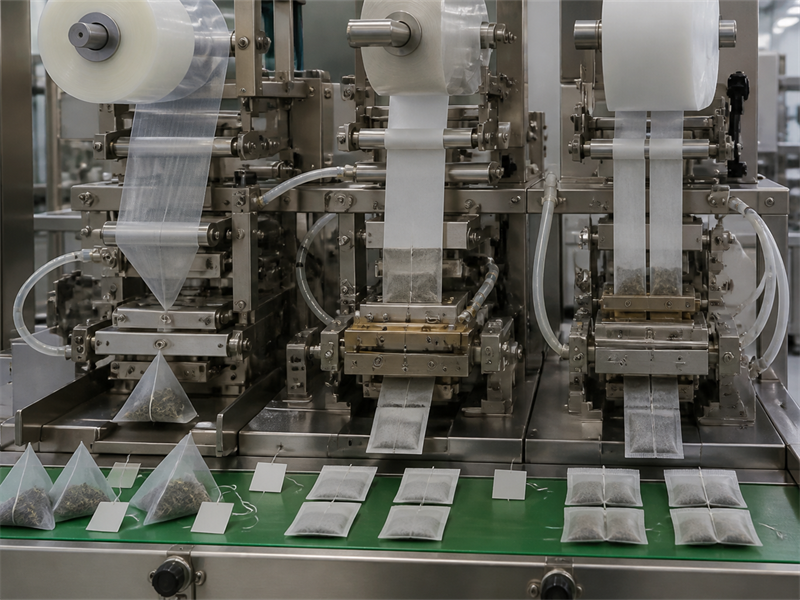
A drip coffee line is more specialized. It may involve filter-paper forming, coffee dosing, ultrasonic sealing, individual outer-bag packaging, and secondary packaging.
This distinction matters when sourcing equipment. A supplier quoting a machine based only on "bags per minute" is not giving you the complete picture.
The better question is:
How many good, correctly filled, properly sealed bags can the system produce during a normal production shift?
That number is much more useful for calculating real coffee production efficiency.
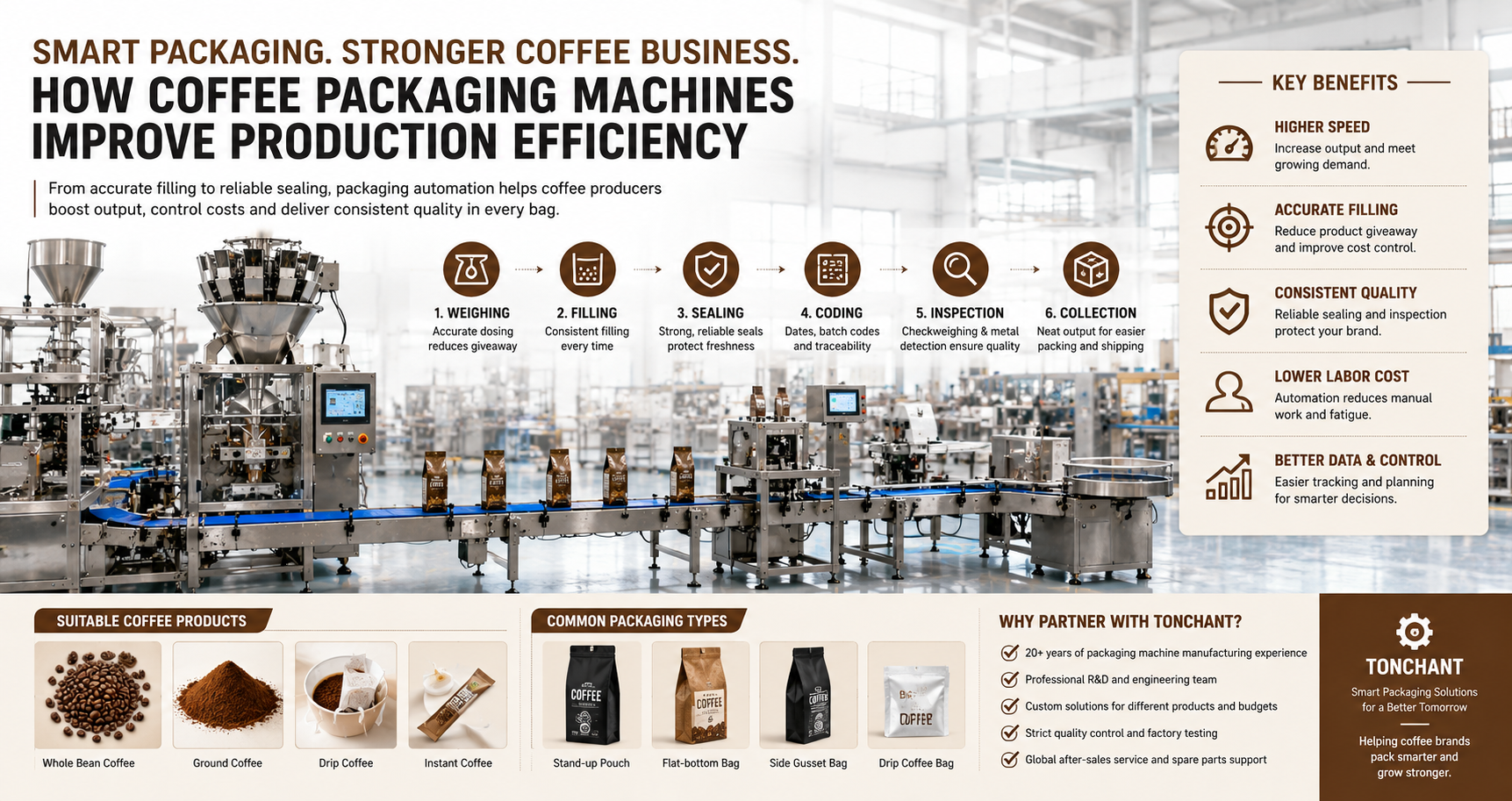
How Coffee Packaging Machines Improve Production Efficiency
1. They Remove the Packaging Bottleneck
Imagine a coffee roaster capable of producing several tons of roasted coffee each day.
The roasting equipment is not the problem. The problem appears later.
Ten operators are manually weighing and filling bags, and finished products are waiting for packaging. When orders suddenly increase before a holiday or promotional campaign, the company has to add overtime shifts just to keep up.
This is a common point where automation starts to make financial sense.
A packaging machine can continuously dose, fill, and seal coffee at a predictable rate. Instead of adding more people every time demand increases, the business gains additional production capacity from the equipment itself.
That does not mean labor becomes unnecessary. Operators still need to load packaging materials, monitor the machine, perform quality checks, and handle changeovers. But their time is used more effectively.
2. More Consistent Filling
Coffee is not an especially easy product to dose.
Whole beans vary in size and shape. Ground coffee has different flow characteristics depending on grind size, roast level, and density. Freshly roasted coffee can also behave differently from coffee that has been stored for several days.
Manual filling makes consistency difficult.
One operator may consistently fill a little above the target weight. Another may be more conservative. Over thousands of bags, a small difference becomes expensive.
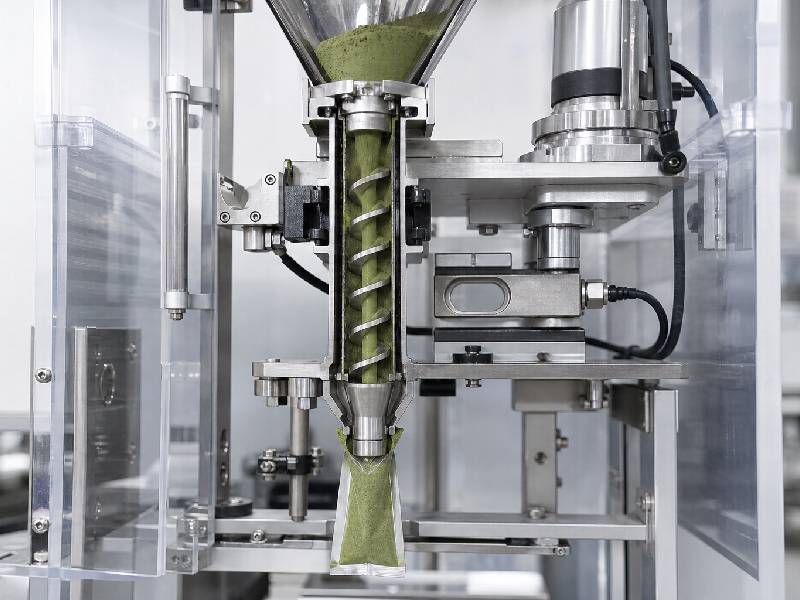
Automated weighing and dosing systems can control the target quantity much more consistently.
For example, if a 250 g bag is repeatedly overfilled by several grams, the lost coffee may appear insignificant on one package. Multiply that by 20,000 or 100,000 bags, and the cost becomes much easier to see.
This is one reason filling accuracy should be part of the ROI calculation when evaluating a coffee packaging machine.
3. Less Repetitive Manual Work
Manual packaging involves many repetitive actions:
-
Picking up empty bags
-
Opening bags
-
Weighing coffee
-
Pouring coffee
-
Checking weight
-
Wiping the seal area
-
Sealing the bag
-
Applying labels
-
Moving finished bags
These tasks are manageable at 500 bags a day.
They become a very different problem at 10,000 bags a day.
Automation moves much of this repetitive work into the machine. Employees can then concentrate on machine operation, inspection, material preparation, maintenance, and quality control.
For manufacturers dealing with rising labor costs, this can have a significant impact on the economics of production.
4. Better Sealing Means Fewer Packaging Problems
Coffee freshness is closely tied to packaging performance.
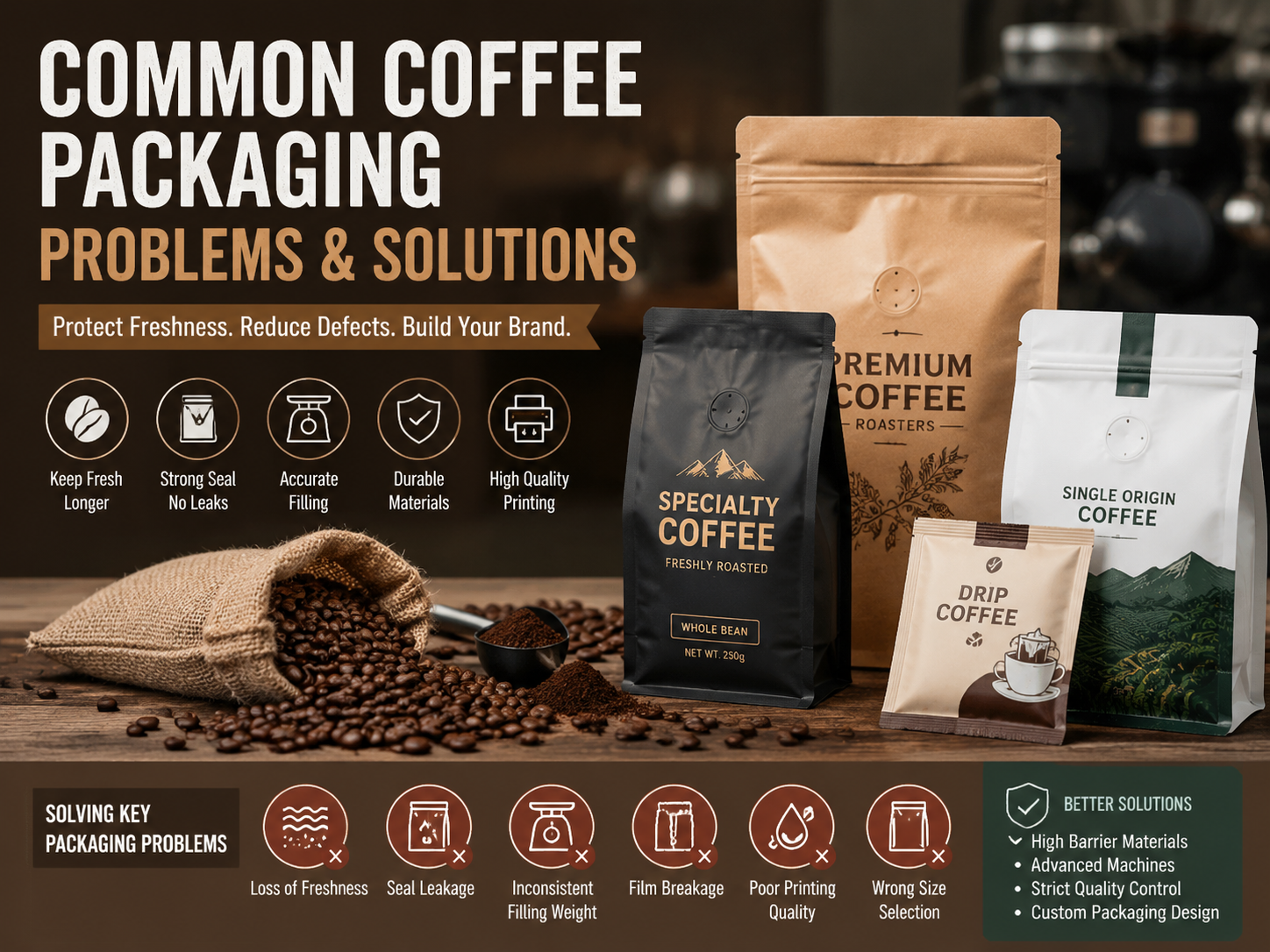
Roasted coffee is sensitive to oxygen, moisture, light, and external contamination. Many coffee brands therefore use high-barrier packaging, often combined with a one-way degassing valve.
But even a high-quality packaging material cannot compensate for a poor seal.
A package with wrinkles in the sealing area, incomplete sealing, contamination around the seal, or inconsistent sealing pressure can cause problems later.
Automatic sealing systems provide much more controlled sealing conditions. Temperature, pressure, sealing time, and other parameters can be standardized.
For a premium coffee brand, this has another benefit: finished bags look more consistent.
That matters when the product is displayed on a retail shelf or photographed for an online store.
Packaging Materials: The Machine Has to Match the Bag
One of the most overlooked parts of buying packaging equipment is the relationship between the machine and the packaging material.
A machine should not be selected first and packaging material figured out afterward.
The two need to be evaluated together.
Flexible Laminated Coffee Bags
Common structures include:
-
PET/PE
-
MOPP/VMPET/PE
-
PET/AL/PE
-
Kraft paper laminated structures
-
High-barrier recyclable structures
Different films have different stiffness, sealing temperatures, friction characteristics, and forming behavior.
For example, a packaging film that works well on one machine may require different temperature or pressure settings on another.
This is why serious suppliers should test the actual packaging material rather than simply saying, "Yes, the machine can handle laminated film."
High-Barrier Packaging
Coffee packaging commonly requires strong oxygen and moisture protection.
Aluminum foil and metallized films can provide strong barrier properties, while newer mono-material and recyclable structures are increasingly being considered by brands looking to reduce packaging complexity.
However, newer materials may behave differently during sealing.
If sustainability is part of your packaging strategy, tell the machine supplier early in the project. Do not wait until after the equipment has been manufactured.
Paper-Based Coffee Bags
Paper-forward packaging is increasingly popular among brands that want a more natural visual identity or a lower-plastic packaging approach.
But paper-based structures can have different forming and sealing characteristics.
A factory that has experience with multiple packaging materials can usually identify potential problems earlier, particularly around film feeding, bag opening, sealing temperature, and seal strength.
Drip Coffee Packaging Materials
Drip coffee is another category entirely.
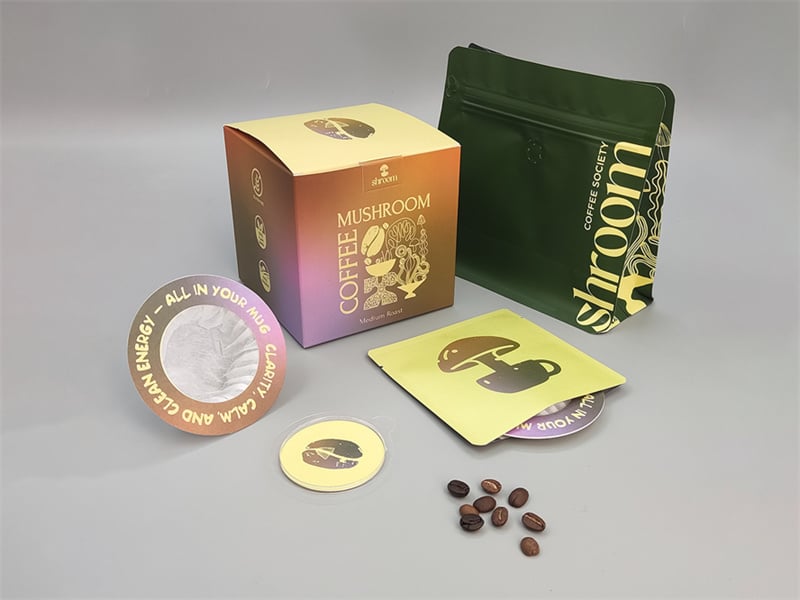
A typical drip coffee bag may use filter paper or non-woven material, while the outer bag generally needs stronger barrier protection.
For example, some drip coffee products use approximately 28 gsm filter paper, while premium versions may use higher-performance non-woven filter materials.
The machine needs to accommodate the characteristics of these materials during forming and sealing.
At Tonchant, packaging projects often involve different combinations of filter materials, outer films, paper boxes, and bag formats. From a manufacturing perspective, testing the complete packaging combination is much more useful than evaluating one component in isolation.
Where Coffee Packaging Machines Are Used
There is no single "best" coffee packaging machine. The right configuration depends on the business.
Coffee Roasters
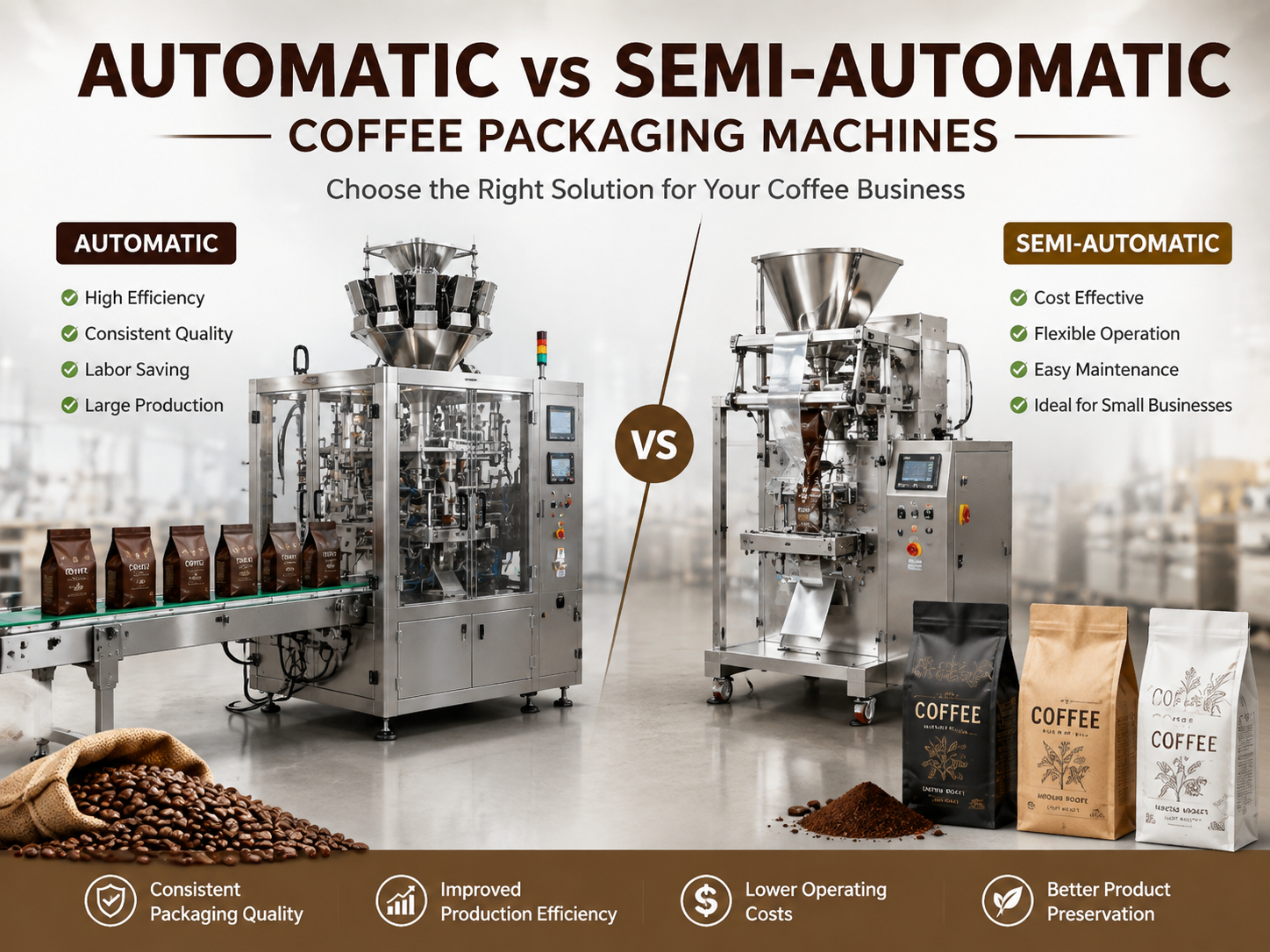
Small and medium-sized roasters often start with manual or semi-automatic packaging.
Once production becomes more predictable, automation becomes easier to justify.
A roaster producing 1,000 bags per week does not necessarily need the same equipment as a company producing 20,000 bags per day.
Industrial Coffee Manufacturers
Large coffee manufacturers usually need a complete automatic packaging line.
The machine may be integrated with:
-
Automatic weighing
-
Filling systems
-
Nitrogen flushing
-
Sealing
-
Checkweighing
-
Metal detection
-
Conveyors
-
Cartoning
-
Case packing
At this scale, even a few seconds saved per package can have a noticeable effect on annual production.
Specialty Coffee Brands
Specialty coffee companies often have an unusual requirement: many SKUs but relatively small batches.
One product may be a 100 g light roast, another a 250 g espresso blend, and another a 500 g single-origin coffee.
In this case, changeover time becomes extremely important.
A machine that is slightly slower but can change between bag sizes quickly may actually be more productive than a faster machine that takes a long time to reset.
Drip Coffee Manufacturers
Drip coffee requires specialized packaging equipment.
The production process may include forming the filter bag, filling it with coffee, sealing the filter, packaging it in an individual outer pouch, and then packing multiple units into a carton.
For these products, machine integration becomes particularly valuable because there are several packaging stages.
The Real Advantages of Packaging Automation
The benefits of automation go beyond speed.
| Factor | Manual Packaging | Semi-Automatic | Automatic Packaging System |
|---|---|---|---|
| Filling consistency | Operator dependent | Good | High |
| Labor requirement | High | Medium | Lower |
| Production speed | Low | Medium | High |
| Seal consistency | Variable | Good | Highly consistent |
| Production planning | Difficult | Easier | More predictable |
| Waste control | Limited | Improved | Strong |
| Changeover | Manual | Moderate | Faster with proper design |
| Data monitoring | Limited | Some | More comprehensive |
| Suitable volume | Small | Small-Medium | Medium-Large |
| Expansion potential | Limited | Good | Excellent |
For a growing business, the biggest advantage may actually be predictability.
If management knows that a packaging line can consistently deliver a certain production rate, scheduling becomes easier. Purchasing can plan packaging materials more accurately, warehouse teams can prepare for incoming finished goods, and sales teams can have greater confidence when accepting larger orders.
Customization: Don't Buy More Machine Than You Need
Customization is often discussed in terms of extra features, but the better approach is to customize around your actual production requirements.
Bag Size
A machine may need to handle:
-
100 g
-
125 g
-
250 g
-
500 g
-
1 kg
If you currently sell only 250 g coffee but expect to introduce larger bags next year, tell the supplier.
Planning for future sizes during the original machine design may be cheaper than modifying the equipment later.
Filling Technology
Whole beans and ground coffee do not necessarily require the same dosing method.
Possible systems include:
-
Multi-head weighing
-
Linear weighing
-
Auger filling
-
Volumetric dosing
The right choice depends on the coffee's characteristics, required accuracy, production speed, and package size.
Nitrogen Flushing
If your freshness strategy requires reduced oxygen inside the bag, nitrogen flushing can be integrated into the packaging process.
The effectiveness of gas flushing also depends on the bag material, sealing performance, filling process, and overall packaging design.
Coding
Automatic coding can add production and traceability information such as:
-
Production date
-
Best-before date
-
Batch number
-
Lot number
-
QR code
This becomes increasingly useful as production volumes grow.
Inspection
Larger systems can include checkweighers, metal detectors, and vision inspection.
These components add cost, but they can also prevent defective packages from reaching customers.
For a small operation, they may not be essential. For an industrial manufacturer shipping hundreds of thousands of packages, the economics are different.
MOQ: Think Beyond the Machine
MOQ is often associated with packaging bags, but machine buyers should also think about how MOQ affects the overall project.
A standard machine may be available with relatively straightforward specifications.
A heavily customized system may require:
-
Special tooling
-
Custom filling components
-
New bag-handling parts
-
Customized software
-
Additional conveyors
-
Special sealing systems
Packaging material MOQ is another consideration.
Printed coffee bags often have minimum quantities because of printing setup, raw material purchasing, production scheduling, and inventory requirements.
For a new coffee brand, this creates an interesting sourcing problem.
You may want a highly automated packaging line, but if your packaging-material MOQ is too high, you could end up holding excessive packaging inventory.
The best sourcing strategy considers machine capacity, packaging MOQ, product demand, and inventory turnover together.
Lead Time: What Buyers Should Actually Ask
Machine suppliers often quote a manufacturing lead time, but that is only one part of the project.
A typical process is:
Technical confirmation → Design → Component procurement → Manufacturing → Assembly → Testing → Factory acceptance → Shipment → Installation
The actual timeline depends on machine complexity and supplier production schedules.
When requesting a quotation, ask:
-
Is the machine standard or customized?
-
Which components have long procurement times?
-
Is factory testing included?
-
Can the supplier test our actual coffee?
-
Can our packaging bags be tested before shipment?
-
Is installation support available?
-
Is operator training included?
-
How quickly can spare parts be supplied?
This is where factory experience matters.
At Tonchant, packaging projects are not treated purely as equipment transactions. Product dimensions, material structures, filling weights, and the final packaging format all need to work together. Testing the packaging process before mass production can identify issues that would otherwise appear after the equipment arrives at the customer's factory.
For an overseas buyer, that pre-shipment testing can save considerably more time than it costs.
Certificates and Compliance
Certification requirements depend on the machine, destination market, and components used.
Depending on the project, buyers may need documentation such as:
-
CE-related machinery compliance documentation
-
Electrical safety documentation
-
EMC documentation
-
Food-contact declarations for product-contact components
-
Material compliance documents
-
Factory quality-control records
One important sourcing point is to distinguish between machine certification and packaging-material certification.
For example, a coffee bag may require food-contact compliance documentation, while the packaging machine may need machinery and electrical safety documentation.
Do not simply ask a supplier, "Does this machine have CE?"
Ask for the actual documentation and verify that it corresponds to the specific machine model being purchased.
A Practical Buyer Scenario: When Should You Automate?
Consider a coffee company producing around 5,000 bags per day.
The company currently employs several workers to weigh, fill, seal, and label the bags. During normal weeks, the system works. When a large supermarket order arrives, overtime becomes necessary.
The company considers an automatic packaging machine.
The first mistake would be to compare machines based only on maximum bags per minute.
Instead, management should calculate:
Actual daily demand + labor cost + overtime + coffee giveaway + packaging waste + downtime + future growth
Then compare that figure with the total cost of ownership of the machine.
Now consider another business.
A specialty roaster produces only 2,000 bags per day but has 12 different SKUs.
A very fast industrial machine may not be the best choice. If every SKU change requires lengthy adjustments, much of that theoretical speed disappears.
A flexible machine with quick changeover could be the better investment.
This is why there is no universal answer to the question, "What is the most efficient coffee packaging machine?"
Efficiency depends on the production environment.
How to Calculate Coffee Packaging Machine Efficiency
A simple calculation is useful when comparing equipment.
Instead of looking only at rated speed, consider:
Effective Output = Rated Speed × Operating Time × Actual Utilization Rate
For example, a machine may be advertised at 50 bags per minute.
That sounds impressive.
But if changeovers, cleaning, material loading, adjustment, minor stoppages, and quality checks reduce the effective utilization rate to 70%, the practical output is significantly lower than the headline figure.
A supplier that provides realistic test data is much more valuable than one that simply advertises the highest theoretical speed.
For serious purchasing decisions, ask suppliers to run your actual:
-
Coffee
-
Bag size
-
Packaging film
-
Target weight
-
Sealing configuration
The results will tell you far more than a brochure.
Manual vs. Semi-Automatic vs. Automatic
| Feature | Manual | Semi-Automatic | Automatic |
|---|---|---|---|
| Initial investment | Low | Medium | High |
| Labor requirement | High | Medium | Low |
| Production volume | Small | Small-Medium | Medium-Large |
| Flexibility | Very high | High | Medium-High |
| Filling consistency | Variable | Good | High |
| Production planning | Difficult | Moderate | Predictable |
| Maintenance | Simple | Moderate | More specialized |
| Future expansion | Limited | Good | Excellent |
| Best suited for | Testing/small batches | Growing roasters | High-volume production |
There is no shame in starting with manual packaging.
For a new brand testing the market, keeping capital expenditure low can be the smarter decision.
But once demand becomes stable, continuing to rely on manual packaging simply because "that is how we have always done it" can become expensive.
FAQ
What is the biggest benefit of a coffee packaging machine?
For most growing coffee businesses, the biggest benefit is consistency. Automation improves filling, sealing, production speed, and workflow predictability at the same time.
How fast can a coffee packaging machine run?
There is no single answer. Speed depends on bag size, coffee type, dosing method, packaging material, and machine configuration.
Always ask for tested output using your actual product.
Is automation suitable for a small coffee roaster?
Yes, but full automation may not be necessary. Semi-automatic equipment can be a good stepping stone for businesses that are still growing.
Can one machine package several bag sizes?
Many systems can handle multiple bag sizes, but the range depends on the machine. Ask about changeover time and whether additional tooling is required.
Can recyclable coffee packaging be used on automatic machines?
Often, yes. However, recyclable materials can have different sealing and forming characteristics. Testing is strongly recommended before equipment is finalized.
Is nitrogen flushing necessary?
Not for every coffee product. It depends on the packaging structure, freshness strategy, product requirements, and desired shelf life.
How much labor can automation save?
There is no universal percentage because labor requirements depend on the existing process and machine configuration. A supplier should evaluate the complete workflow rather than make a generic labor-saving claim.
What should I send a machine supplier when requesting a quotation?
Provide the coffee type, target weight, bag style, dimensions, material structure, daily production volume, number of SKUs, required packaging speed, destination market, and certification requirements.
Photos or physical samples of the packaging are even better.
What to Look for When Sourcing From a Factory
Price is important, but it should not be the only comparison point.
When evaluating suppliers, look at the complete package.
Manufacturing Capability
Does the supplier actually manufacture the equipment, or is it primarily acting as a trading company?
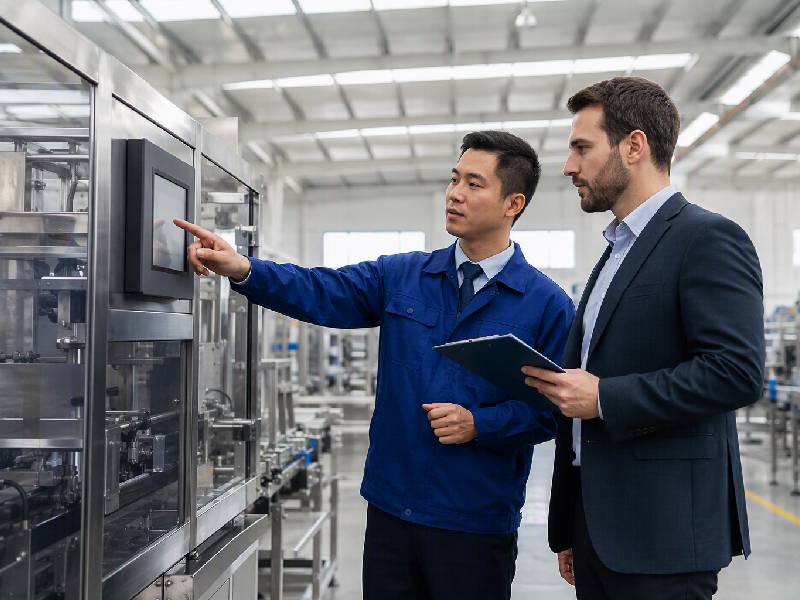
A factory with its own engineering and assembly capabilities may be better positioned to customize equipment and troubleshoot production issues.
Packaging Knowledge
A machine supplier should understand coffee packaging, not just machinery.
They should be able to discuss film thickness, barrier structures, bag dimensions, sealing behavior, coffee density, filling accuracy, and packaging defects.
Testing Capability
Ask whether the supplier can test your actual materials.
This is particularly important when using customized coffee bags, recyclable films, specialty filter paper, or unusual package dimensions.
After-Sales Support
A packaging machine is a long-term production asset.
Ask about:
-
Spare parts
-
Remote support
-
Installation
-
Training
-
Maintenance instructions
-
Troubleshooting
-
Warranty terms
A slightly cheaper machine can become expensive if technical support is difficult to obtain.
Conclusion
The purpose of coffee packaging automation is not simply to make a production line look more advanced.
It is about solving practical problems.
If employees are spending hours on repetitive filling, if coffee is being overfilled, if sealing quality varies, if orders are delayed because packaging cannot keep up with roasting, or if production planning becomes difficult during peak periods, automation may offer a strong solution.
The right coffee packaging machine can improve speed, accuracy, labor utilization, sealing consistency, and overall coffee production efficiency.
But the machine itself is only part of the equation.
Packaging materials, coffee characteristics, bag design, production volume, SKU count, changeover requirements, MOQ, lead time, certification, maintenance, and future expansion all need to be considered before making the investment.
For buyers working with an experienced packaging manufacturer such as Tonchant, the most productive approach is to evaluate the complete packaging system rather than purchasing equipment in isolation. Testing the actual coffee and packaging materials before production can help identify problems early and create a much more reliable path to mass production.
Ultimately, the best automatic packaging system is not necessarily the fastest machine on paper.
It is the system that delivers reliable output, consistent quality, manageable operating costs, and enough flexibility to support the business as it grows.
That is what meaningful coffee packaging machine efficiency looks like in the real world.