
 EN
EN
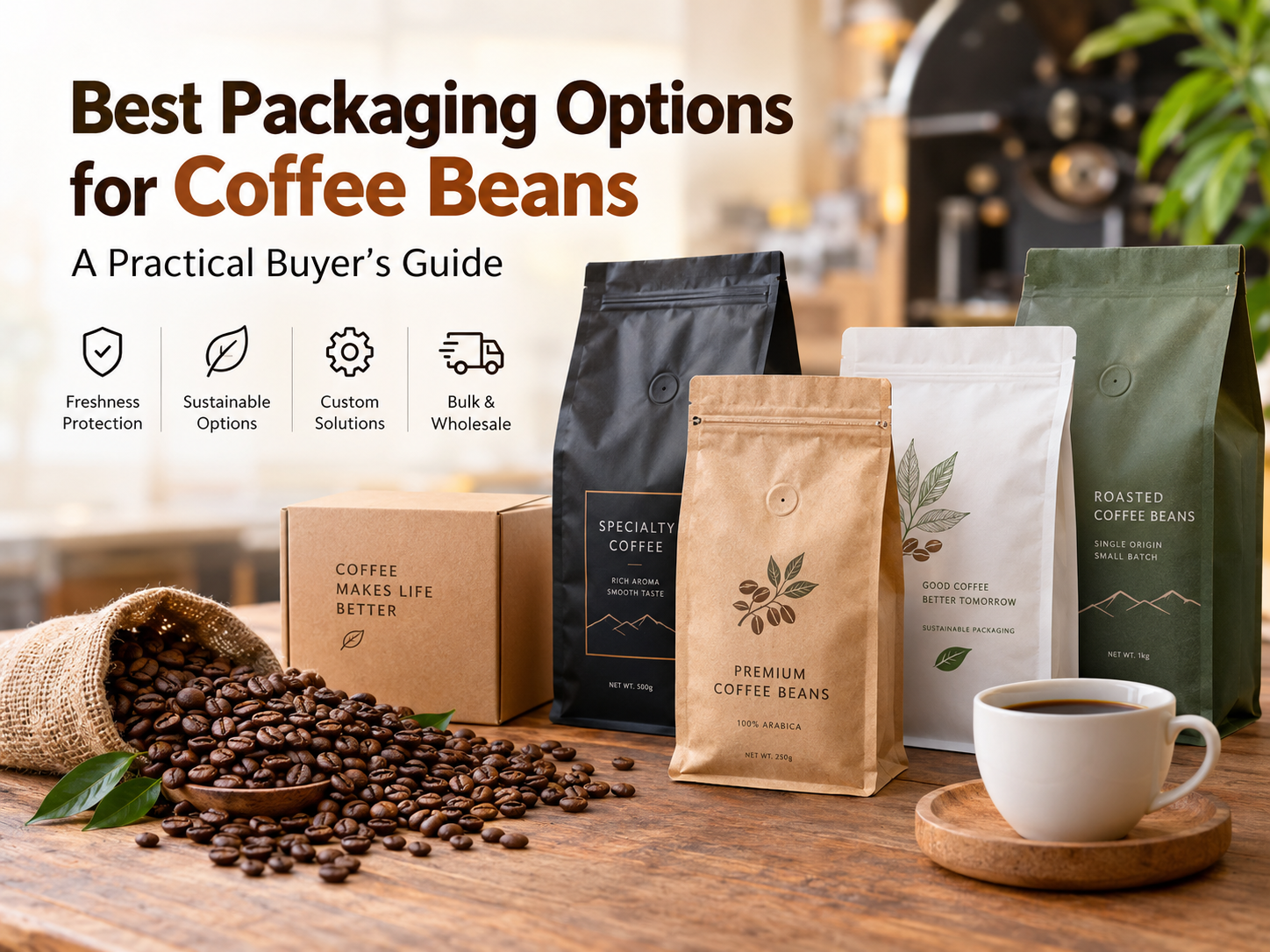
Best Packaging Options for Coffee Beans: A Practical Buyer’s Guide
Introduction
A great coffee can lose its appeal long before it reaches the customer if the packaging is not doing its job.
Once coffee beans are roasted, they become highly sensitive to oxygen, moisture, light, and outside odors. They also continue releasing carbon dioxide after roasting. That creates a packaging challenge that is easy to underestimate: the bag has to protect the coffee while also being practical to fill, seal, transport, store, display, and eventually open.
For a small specialty roaster ordering a few thousand bags, the decision may come down to appearance, MOQ, and freshness. For a restaurant chain buying hundreds of kilograms every month, the priorities are very different. Packaging cost, warehouse space, transport durability, and compatibility with filling equipment can quickly become more important than the look of the bag.
That is why there is no single "best" coffee bag for every business.
The right coffee bean packaging depends on how much coffee you sell, where it goes, how long it needs to remain fresh, how it will be packed, and what your customers expect when they see it on the shelf.
This guide looks at the most practical options and the issues buyers should consider before placing a custom packaging order.
What Is It?
Coffee bean packaging is the packaging system used to protect and contain roasted whole beans from the point of packing through transportation, storage, and final consumption.
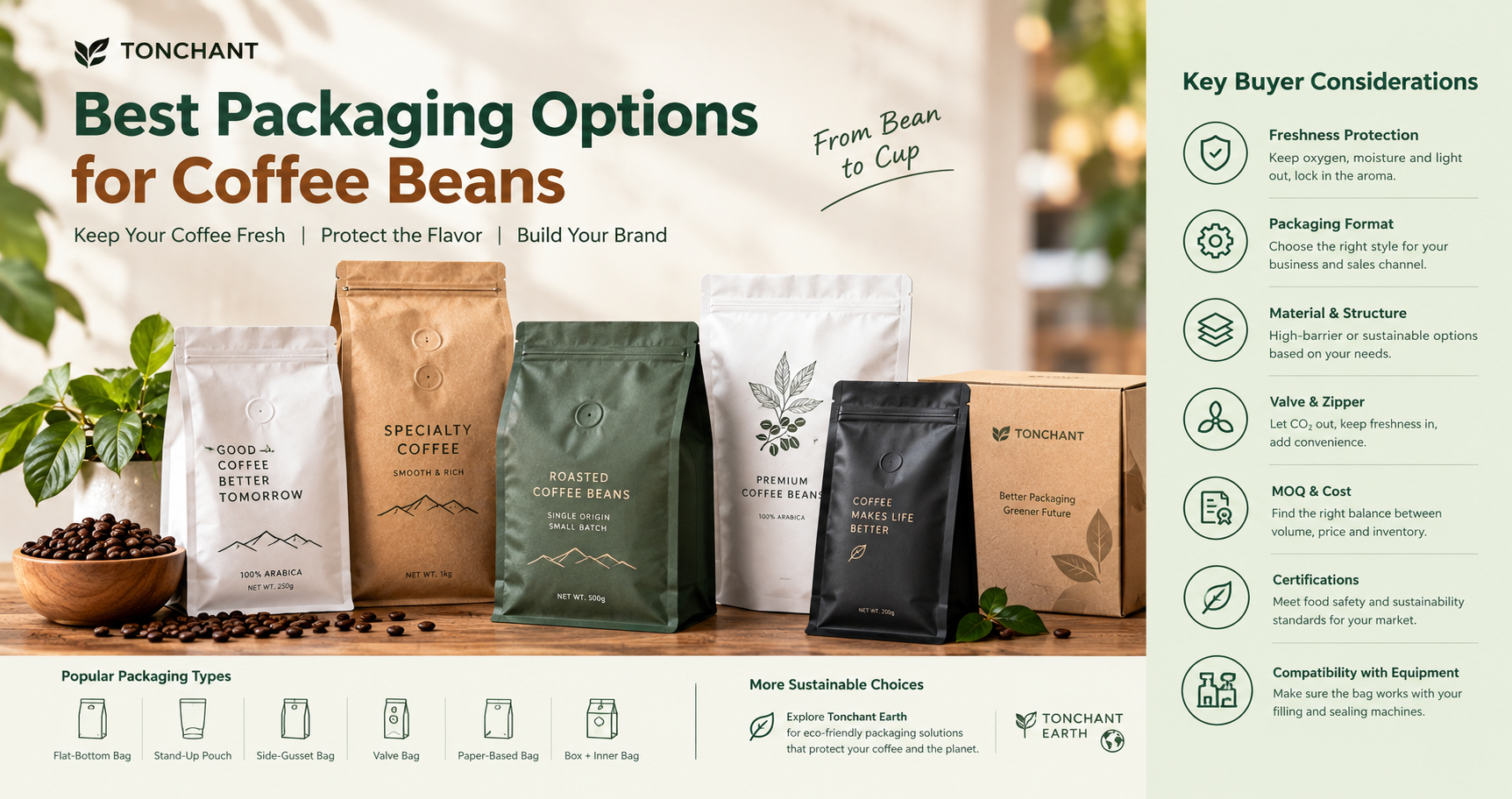
The most common formats include flat-bottom bags, stand-up pouches, side-gusset bags, and other flexible laminated coffee bags. Some are designed primarily for retail shelves, while others are built around cost-efficient bulk distribution.
Regardless of the shape, good coffee packaging needs to do several things well:
-
Limit oxygen exposure
-
Control moisture transmission
-
Protect coffee from light when necessary
-
Reduce exposure to external odors
-
Provide reliable heat sealing
-
Allow freshly roasted coffee to release CO₂
-
Survive normal handling and transportation
-
Present the brand professionally
For freshly roasted beans, a one-way degassing valve is often an important part of the package. The valve allows CO₂ to escape without simply leaving the package open to the outside environment.
Common Coffee Bean Packaging Options
| Packaging Type | Best For | Advantages | Potential Drawbacks |
|---|---|---|---|
| Flat-Bottom Bag | Specialty coffee and premium retail | Stable, attractive, excellent shelf presentation | Usually costs more than a basic pouch |
| Stand-Up Pouch | Retail, e-commerce and growing brands | Flexible, practical and relatively cost-effective | Less rigid on the shelf |
| Side-Gusset Bag | Foodservice, wholesalers and larger packs | Good capacity and efficient storage | Traditional appearance |
| Valve Coffee Bag | Freshly roasted beans | Supports degassing and freshness protection | Valve adds component and assembly cost |
| Paper-Based Bag | Sustainability-focused brands | Natural appearance and strong eco positioning | Barrier performance needs careful evaluation |
| Box with Inner Bag | Gift sets and premium products | Strong presentation and additional protection | Higher material and packing cost |
A buyer should not select the format based on appearance alone. The package needs to work with the entire supply chain.
Key Benefits
Protecting Coffee Freshness
The most important job of coffee packaging is to slow the processes that cause roasted coffee to deteriorate.
Oxygen is one of the biggest concerns. Moisture can also affect aroma and texture, while light can become an issue for certain packaging structures and storage environments.
This is why commercial coffee bags often use multiple material layers. A structure might combine an outer printable film, a high-barrier layer, and a heat-sealable inner layer. Common materials include MOPP, PET, metallized films, aluminum, and PE, although the exact structure should be chosen according to the required performance.
At the Tonchant factory, material selection is typically discussed alongside the coffee application rather than treating the bag as a standalone product. A 250g specialty coffee bag going directly to consumers does not necessarily need the same structure as a 1kg foodservice bag moving through a distributor.
That distinction matters when trying to control cost.
Managing CO₂ After Roasting
Freshly roasted coffee releases carbon dioxide. If it is packed too soon in a completely sealed package without a suitable degassing solution, pressure can build inside the bag.
A one-way valve provides a practical solution by allowing gas to escape while helping prevent outside air from entering.
For a roaster that packs coffee within a few days of roasting, a valve is usually a sensible investment.
On the other hand, a buyer selling coffee that has already undergone a longer degassing period may have different requirements. The packaging decision should reflect the actual production process rather than following a standard specification blindly.
Making Distribution Easier
Packaging is also a logistics tool.
Imagine a distributor shipping 20,000 coffee bags to several regional warehouses. A bag that is slightly too large, difficult to stack, or prone to seal damage can create problems that are much more expensive than the original packaging price suggests.
Good commercial packaging should be:
-
Consistent in size
-
Resistant to punctures and abrasion
-
Easy to pack into cartons
-
Efficient to stack
-
Compatible with warehouse handling
-
Reliable during long-distance transportation
For restaurant chains in particular, packaging consistency can make inventory management much easier across multiple locations.
Supporting Brand Positioning
Coffee packaging is often the first thing a customer notices.
A specialty coffee brand may want a minimalist flat-bottom bag with a matte finish. A supermarket product may need strong shelf visibility. A subscription coffee company may prioritize packaging that survives parcel delivery.
Custom printing gives brands plenty of room to communicate their identity. Depending on the packaging format, buyers can customize:
-
Logo and brand colors
-
Coffee origin
-
Roast level
-
Flavor notes
-
Brewing instructions
-
QR codes
-
Product information
-
Sustainability information
-
Surface finish
-
Valve and zipper placement
The best design is not necessarily the busiest one. In coffee retail, clear hierarchy often works better: brand first, coffee name second, useful product information third.
Creating More Sustainable Packaging Choices
Sustainability has become a serious purchasing consideration, especially for European buyers and brands selling to environmentally conscious consumers.
But there is an important industry lesson here: sustainable packaging still needs to protect the product.
If a package uses fewer materials but allows coffee to lose freshness significantly faster, the environmental benefit becomes more complicated. Wasted coffee carries its own environmental cost.
Buyers considering recyclable, paper-based, or compostable structures should therefore look beyond marketing terminology and ask for actual documentation and performance data.
Tonchant Earth is one option for buyers exploring sustainability-focused packaging, but the material should still be selected according to the coffee's barrier requirements, market regulations, and end-of-life infrastructure.
Applications
Different coffee businesses tend to make different packaging decisions.
Specialty Coffee Roasters
A small or medium-sized specialty roaster may sell 125g, 250g, or 500g bags.
Suppose a roaster produces three seasonal coffees and wants 2,000 bags of each design. They may care more about premium appearance, valve quality, and manageable MOQ than getting the absolute lowest unit price.
A flat-bottom bag is often attractive in this situation because it stands well on a shelf and gives the brand plenty of printable surface area.
Restaurant Chains
Restaurant groups usually have a different calculation.
Consider a chain with 80 locations, each consuming several kilograms of coffee per week. The company may buy 1kg bags in relatively large quantities.
Here, the purchasing team will probably look closely at:
-
Unit cost
-
Bag strength
-
Shipping efficiency
-
Opening convenience
-
Production consistency
-
Lead time
-
MOQ
-
Warehouse requirements
A beautiful retail bag is not necessarily the best choice for this application. A straightforward, durable bag that performs consistently may deliver much better value.
Food Delivery and E-Commerce Coffee Brands
Online coffee brands have another challenge: the package becomes part of the shipping system.
A coffee bag may be handled multiple times before it reaches the customer. It can be squeezed into a carton, moved through a warehouse, placed in a delivery vehicle, and dropped at a customer's door.
For these businesses, puncture resistance and seal quality deserve as much attention as printing.
Distributors and Wholesalers
Wholesalers usually focus heavily on economics and supply stability.
A distributor may need several bag sizes, perhaps 250g for retail customers and 1kg for foodservice accounts. Buying everything from one supplier can simplify procurement, but only if the supplier can maintain consistent material and printing quality across multiple SKUs.
At larger volumes, even a small difference in unit cost can become significant. However, buyers should also consider production lead time and minimum order quantities. A lower price is not attractive if the required MOQ leaves the warehouse full of packaging that will not be used for another year.
Sustainability-Focused Coffee Brands
For brands with sustainability at the center of their positioning, packaging decisions require more research.
Recyclable mono-material structures, paper-based solutions, compostable materials, and reduced-material designs can all be considered, but their suitability depends on the market and product.
A European retailer, for example, may have different packaging expectations and regulatory requirements from a coffee distributor serving the Middle East or North America.
That is why certification and destination-market compliance should be discussed before production rather than after the bags have been printed.
Buying Guide
1. Start With the Coffee Weight
Before discussing artwork, determine the actual fill weight.
Common commercial sizes include:
-
125g
-
250g
-
500g
-
1kg
The same nominal weight can require different dimensions depending on bean density, roast level, and bag construction. It is best to test the actual coffee in a sample bag before finalizing dimensions.
2. Choose the Format Based on the Sales Channel
A simple starting point looks like this:
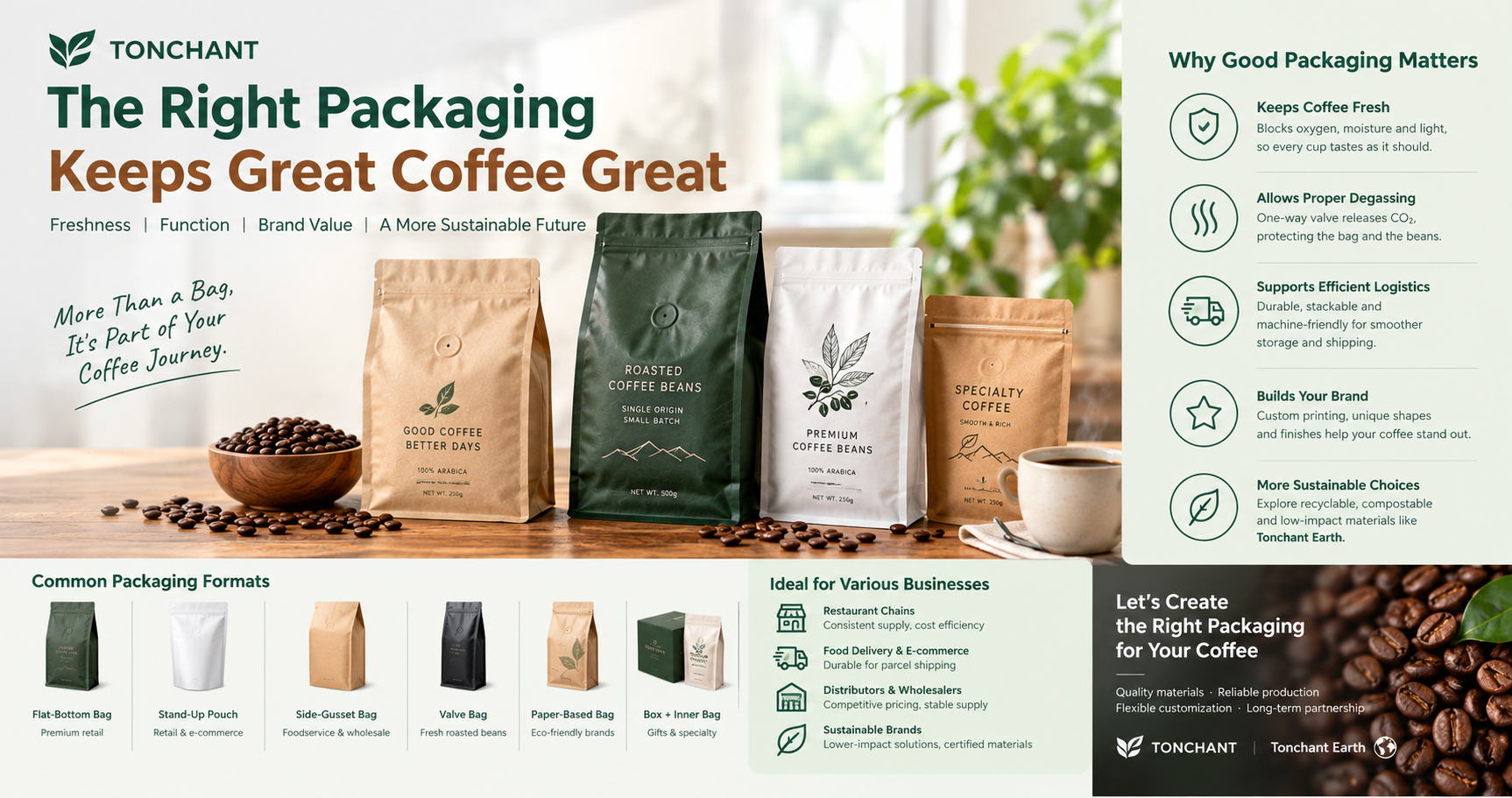
| Business Requirement | Practical Choice |
|---|---|
| Premium retail coffee | Flat-bottom bag |
| Cost-conscious retail packaging | Stand-up pouch |
| Restaurant and foodservice | Larger side-gusset or pouch |
| Freshly roasted beans | High-barrier bag with valve |
| E-commerce coffee | Durable stand-up or flat-bottom bag |
| Sustainability-focused brand | Certified recyclable, paper-based or compostable structure where suitable |
There is plenty of room for customization within each category.
3. Select the Material Carefully
Do not ask only, "What is your cheapest material?"
Instead, ask what barrier performance the coffee actually needs.
A conventional high-barrier structure such as MOPP + PET + PE may be appropriate for many commercial coffee applications. Other projects may use aluminum, metallized films, paper layers, or mono-material structures.
The choice should consider:
-
Required shelf life
-
Roasting and filling process
-
Storage conditions
-
Transportation distance
-
Product positioning
-
Sustainability goals
-
Target-market requirements
A good packaging supplier should be able to explain why a particular structure is being recommended.
4. Decide Whether You Need a Valve or Zipper
A valve is mainly about degassing. A zipper is about consumer convenience.
They solve different problems.
For example, a 250g specialty coffee package intended to be opened over several days may benefit from both.
A 1kg foodservice bag that is emptied quickly after opening may not need the same closure system.
This is one area where buyers can sometimes reduce unnecessary packaging costs without compromising the product.
5. Think About Customization Early
Custom coffee packaging can include:
-
Different bag dimensions
-
Custom printing
-
Matte or glossy finishes
-
Kraft-style appearance
-
Zippers
-
Valves
-
Tear notches
-
Special shapes
-
Windows
-
Custom labels
Ask the supplier for a dieline before preparing the final artwork. This helps prevent common problems such as text being too close to a seal, artwork crossing a gusset, or a valve covering an important design element.
6. Don't Ignore MOQ
MOQ is one of the most common concerns for smaller coffee brands.
A supplier may quote an attractive unit price at 20,000 or 50,000 bags, but that does not necessarily make sense for a business that sells only 3,000 bags per year.
A practical way to think about MOQ is:
Packaging cost = unit price + setup costs + inventory cost + storage cost + potential obsolete stock
For example, a new coffee brand launching four flavors may prefer a slightly higher unit price with a manageable MOQ rather than ordering 50,000 bags for each flavor.
At the other end of the market, a large distributor should negotiate around production volume, repeat orders, and annual purchasing rather than treating every order as an isolated transaction.
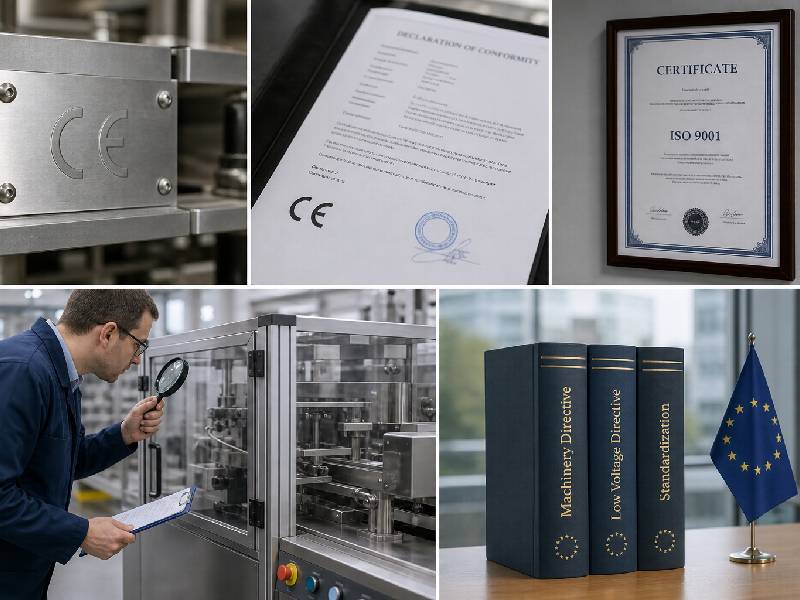
7. Check Certifications Before Ordering
Certification requirements vary according to the material and destination market.
Depending on the project, buyers may need documentation covering:
-
Food-contact compliance
-
Migration testing
-
Material composition
-
Recyclability claims
-
Compostability claims
-
FSC certification for relevant paper materials
-
EU requirements
-
U.S. requirements
-
Other destination-market standards
This is especially important for sustainability claims.
"Eco-friendly" is a broad marketing phrase. A buyer should ask exactly what certification supports the claim and whether the certification applies to the complete packaging structure.
8. Test the Package With Your Production Line
This step is often overlooked.
A bag can look perfect as a sample and still cause problems during production.
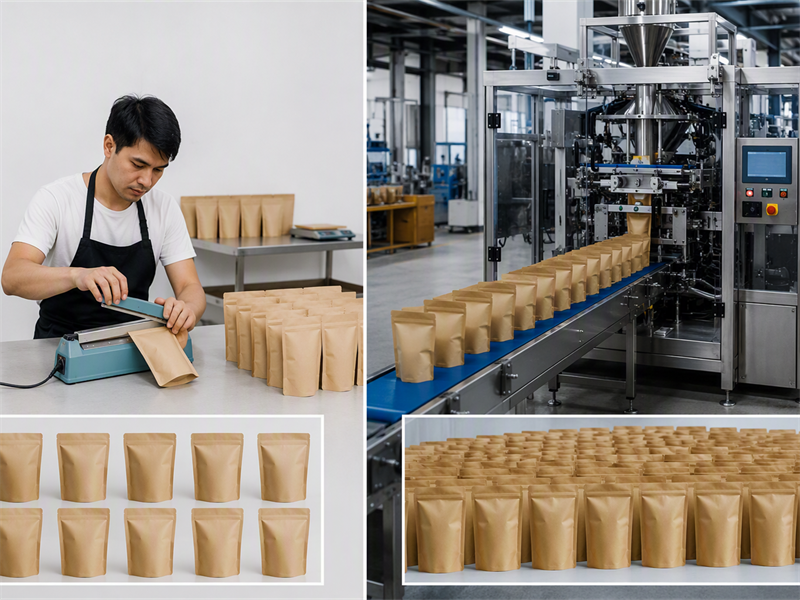
If you plan to move from manual packing to automated equipment, tell the packaging supplier early. Bag dimensions, stiffness, opening behavior, sealing area, and material characteristics can all affect machine performance.
For ground coffee operations, a coffee powder filling machine, coffee powder packing machine, or other coffee powder packaging equipment may require a specific bag structure and format.
The packaging should be developed with the machine—not designed first and tested afterward.
Common Buyer Concerns
"Why can't I use a simple paper bag?"
Because ordinary paper provides limited protection against oxygen and moisture.
Paper can certainly be part of a coffee package, but it usually needs an appropriate barrier layer if the product requires meaningful shelf-life protection.
"Should I always choose the cheapest bag?"
No.
A cheaper bag can become expensive if it results in seal failures, damaged packages, poor shelf life, or customer complaints.
A better purchasing strategy is to compare the total cost of ownership. For high-volume coffee businesses, consistency and reliability can be worth more than saving a few cents per bag.
"Do I really need a degassing valve?"
If you pack freshly roasted whole beans, a valve is often a worthwhile feature.
The exact requirement depends on how soon the beans are packed after roasting and how the coffee is stored and distributed.
"Is sustainable packaging more expensive?"
Sometimes, but not always.
The cost depends on the material, structure, printing, MOQ, certifications, and production volume.
More importantly, sustainability should not be evaluated independently from product protection. A package needs to meet both environmental and functional objectives.
For businesses exploring lower-impact packaging, Tonchant Earth can be part of the sourcing discussion, particularly when the brand has clear sustainability requirements.
"Can my supplier handle large repeat orders?"
This is worth asking before the first production run.
For a growing coffee brand, the first order may be only 5,000 bags. Six months later, the requirement could be 50,000.
A reliable supplier should be able to discuss production capacity, lead times, material sourcing, quality control, and repeat-order consistency.
From a factory perspective, this is one reason it is useful to establish specifications early. Keeping the material structure, dimensions, printing requirements, and valve specifications consistent makes repeat production much easier to manage.
FAQ
1. What is the best packaging for coffee beans?
For freshly roasted retail coffee, a high-barrier flat-bottom or stand-up bag with a one-way valve is often a practical choice. However, the best option depends on the coffee weight, shelf-life target, sales channel, budget, and distribution conditions.
2. Is a flat-bottom bag better than a stand-up pouch?
Not necessarily. Flat-bottom bags usually offer stronger shelf stability and a more premium appearance, while stand-up pouches can be more flexible and economical. The better choice depends on your sales channel and packaging budget.
3. What material is best for coffee bean packaging?
There is no universal material. High-barrier multilayer structures are widely used because they provide strong oxygen and moisture protection. Recyclable, paper-based, and compostable structures can also be considered when their barrier performance and certification requirements match the application.
4. What MOQ should I expect for custom coffee bags?
MOQ varies by supplier, material structure, printing method, bag size, and customization. Some projects may be possible at around 1,000 pieces, while more complex printed structures can require higher quantities.
Always compare MOQ with your expected annual consumption. Ordering more cheaply can be a poor decision if excess bags sit in storage for years.
5. Can coffee bags be used with automated filling equipment?
Yes, but the bag should be designed around the equipment.
If your operation uses a coffee powder filling machine, coffee powder packing machine, or other coffee powder packaging equipment, provide the machine specifications to the packaging supplier before finalizing the bag. This can prevent filling, feeding, or sealing problems later.
Conclusion
Choosing coffee bean packaging is ultimately a balancing act.
The bag needs to protect the coffee, fit the production process, survive transportation, look right for the brand, and make financial sense at the expected order volume.
For a specialty roaster, that may mean a premium flat-bottom bag with a high-barrier structure, valve, zipper, and custom printing. A restaurant chain may get better value from a durable 1kg bag optimized for distribution and cost. A sustainability-focused brand may prioritize certified recyclable, paper-based, or compostable materials.
There is no reason for every coffee business to use the same solution.
The smartest approach is to start with the actual business requirements: coffee weight, roasting and filling process, expected shelf life, sales channel, transportation conditions, annual volume, MOQ, customization requirements, and destination-market certifications.
From there, work with the packaging supplier to test the material and finished bag before moving into mass production.
For buyers sourcing directly from a manufacturer, factory experience matters. Tonchant's experience with coffee and food packaging allows packaging specifications to be considered alongside filling, sealing, printing, and production requirements rather than treating each part as a separate purchase.
And for companies looking to reduce the environmental impact of their packaging, Tonchant Earth provides another direction to explore.
The goal is simple: protect the coffee first, make the package practical, and build the sustainability and branding requirements around those fundamentals. That approach usually produces a packaging solution that works not only for the next shipment, but also as the coffee business grows.