
 EN
EN
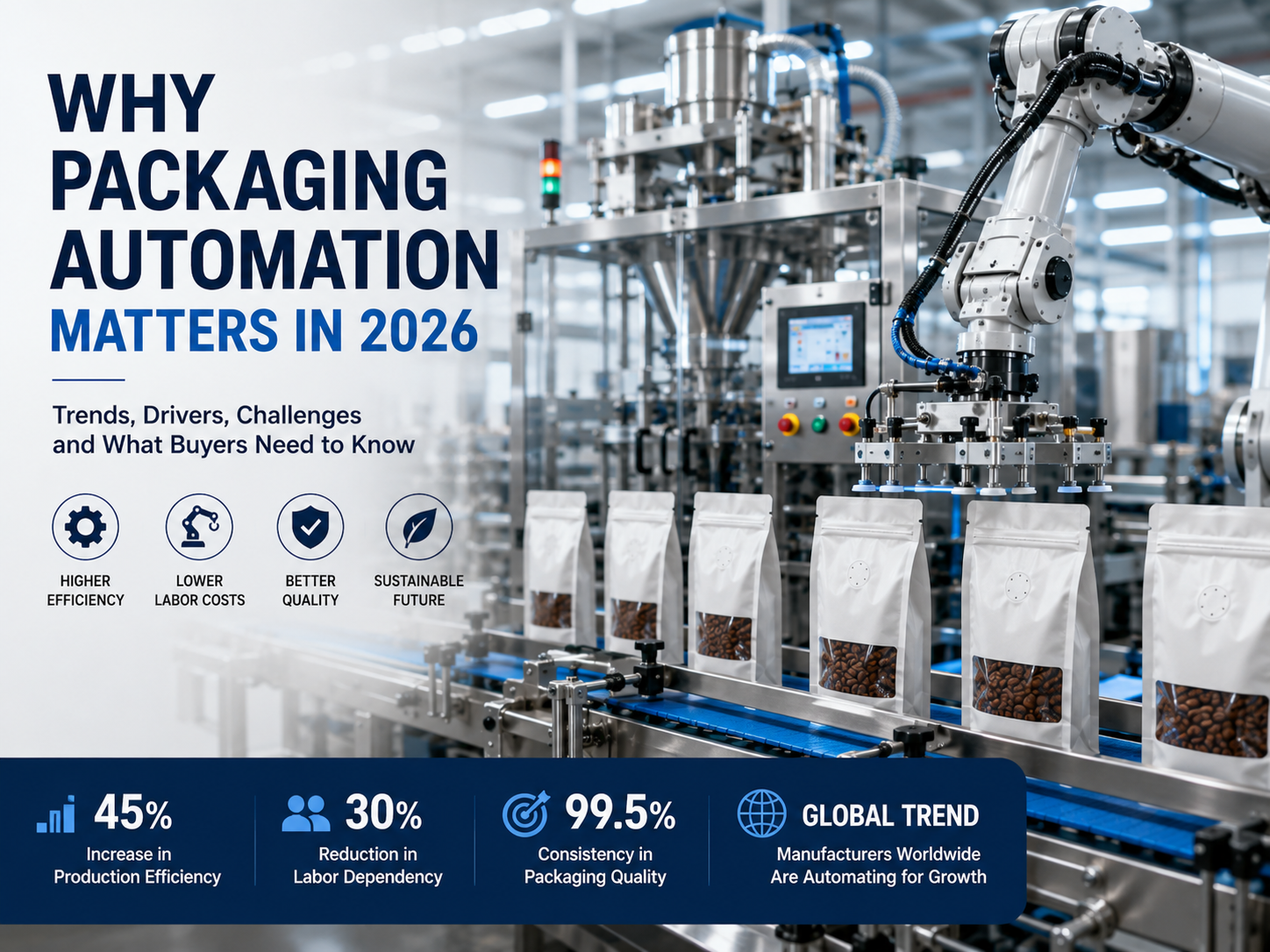
Why Packaging Automation Matters in 2026
Introduction
Packaging has quietly become one of the most strategic investments in modern manufacturing. What was once viewed as the final step before shipping is now a major factor in production efficiency, product quality, sustainability, and supply chain resilience.
In 2026, businesses across the food and beverage sector are under pressure from every direction. Labor shortages continue to affect manufacturing capacity, sustainability regulations are becoming stricter, customers expect shorter lead times, and product portfolios continue to expand. Restaurant chains are introducing more private-label products, food delivery platforms are moving deeper into retail, and distributors are managing an increasing number of packaging formats for different markets.
Against this backdrop, packaging automation has shifted from a long-term aspiration to an immediate business priority. Companies are investing in automated packaging systems not simply to replace manual labor, but to build production lines that are more flexible, data-driven, and capable of adapting to changing market conditions.
Whether sourcing packaging equipment for a new production facility or evaluating manufacturing partners overseas, buyers are increasingly looking beyond machine specifications. They want to understand how automation affects quality consistency, delivery reliability, operating costs, and future scalability.
Industry Background
The packaging industry has undergone remarkable changes over the past decade. Production lines that once relied heavily on manual operations are becoming increasingly connected through robotics, intelligent sensors, vision inspection systems, and digital manufacturing software.
Several long-term developments have accelerated this transformation:
- Rising labor costs across most manufacturing regions
- Greater demand for customized packaging
- Expansion of e-commerce and direct-to-consumer brands
- Higher food safety and traceability standards
- Adoption of recyclable and paper-based packaging materials
- Rapid improvements in robotics and industrial AI
Unlike previous waves of automation that focused mainly on speed, today's investments emphasize flexibility. Manufacturers are expected to switch between different bag sizes, packaging materials, and production batches with minimal downtime while maintaining consistent quality.
This is particularly relevant for coffee, snack foods, frozen foods, pet food, and ready-to-eat meals, where frequent product launches have become part of normal business operations.
 Current Market Trends
Smart Manufacturing Is Becoming the Standard
Today's packaging equipment is expected to do much more than fill and seal products.
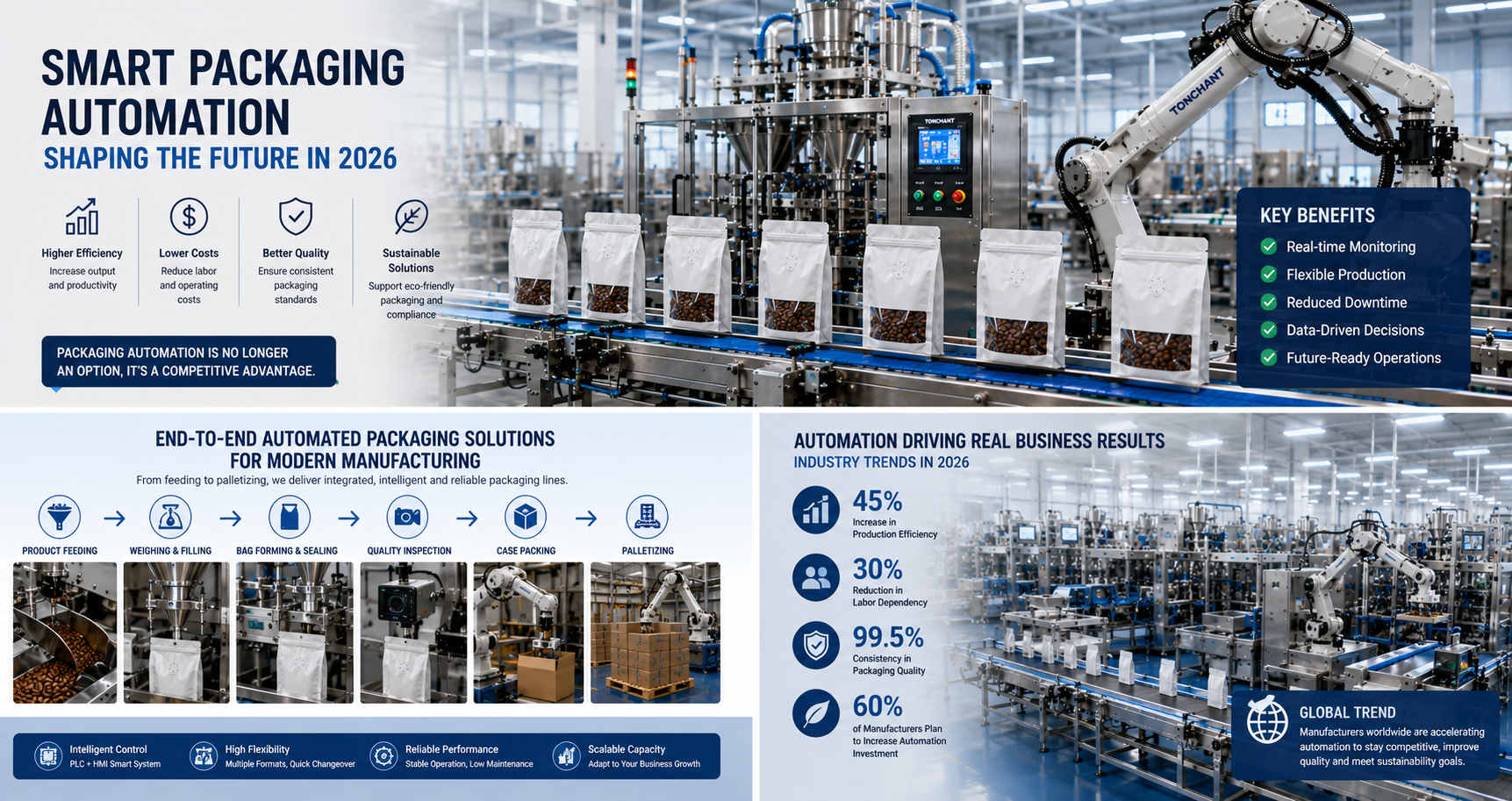
Modern automated packaging systems can monitor production efficiency in real time, communicate with warehouse management software, and generate predictive maintenance alerts before mechanical issues cause costly downtime.
Instead of reacting to problems after production stops, manufacturers are increasingly preventing them before they occur.
Flexibility Has Become More Valuable Than Speed Alone
High production speed remains important, but many manufacturers now prioritize flexibility.
Consider a coffee roaster supplying products to supermarkets, cafés, and online retailers. A single week may require production of retail coffee bags, drip coffee sachets, gift boxes, and promotional packaging.
Changing between formats quickly has become just as valuable as producing thousands of identical packages per hour.
Packaging machinery that supports multiple bag styles without lengthy changeovers allows businesses to respond much faster to market demand.
Sustainability Is Influencing Equipment Decisions
Environmental regulations are reshaping purchasing decisions around the world.
Instead of asking whether equipment can package conventional plastic films, buyers increasingly ask whether it can reliably seal recyclable mono-material structures, paper laminates, or compostable materials.
Machine compatibility with sustainable packaging is becoming a deciding factor, especially for exporters supplying European markets.
Robotics Continue Moving Beyond Large Factories
Robotic automation is no longer reserved for multinational manufacturers.
Medium-sized producers are increasingly adopting collaborative robots for palletizing, case packing, quality inspection, and material handling. Compared with traditional industrial robots, collaborative systems are easier to install, require less floor space, and offer greater flexibility for changing production needs.
AI Is Improving Packaging Quality
Machine vision systems have become significantly more accurate over the past few years.
Instead of relying solely on manual inspection, manufacturers now use AI-assisted cameras to identify sealing defects, incorrect labels, coding errors, damaged pouches, and filling inconsistencies before products leave the production line.
This improves both customer satisfaction and traceability while reducing unnecessary waste.
Global Priorities Driving Packaging Automation
| Industry Priority | Business Impact |
|---|---|
| Smart Monitoring | Better production visibility |
| Robotics | Reduced labor dependency |
| Vision Inspection | Improved quality consistency |
| Sustainable Material Compatibility | Easier regulatory compliance |
| Flexible Changeovers | Faster response to market demand |
| Predictive Maintenance | Lower operating costs |
Key Drivers Behind the Trend
Labor Challenges Continue Worldwide
Manufacturing labor remains difficult to secure in many regions.
North American food manufacturers continue reporting shortages of experienced production workers. European factories face an aging workforce, while manufacturers across Asia are seeing steady wage growth and stronger competition for skilled employees.
Automation provides a practical solution—not because people are being replaced entirely, but because repetitive, physically demanding tasks can be handled more efficiently by machines while employees focus on supervision, quality control, and maintenance.
Regulations Are Raising Expectations
Government policies continue encouraging more sustainable packaging practices.
In Europe, the Packaging and Packaging Waste Regulation (PPWR) is accelerating demand for recyclable packaging and encouraging businesses to rethink both materials and production processes.
Across North America, major retailers have introduced sustainability targets that influence purchasing decisions throughout their supply chains, even where regulations differ between states and provinces.
Meanwhile, countries such as China, Japan, and South Korea continue investing heavily in smart manufacturing initiatives while encouraging higher production efficiency and reduced environmental impact.
These regulatory shifts are influencing equipment purchases just as much as production requirements.
Supply Chain Stability Matters More Than Ever
The disruptions experienced over recent years have fundamentally changed sourcing strategies.
Many importers no longer evaluate suppliers solely on price. Instead, they ask questions about production capacity, equipment redundancy, quality control systems, and digital traceability.
Factories with higher levels of packaging machinery automation often provide more predictable lead times because they are less vulnerable to labor shortages and production fluctuations.
Data Is Becoming a Competitive Advantage
Connected production lines generate valuable operational insights.
Manufacturers can monitor equipment utilization, material waste, production efficiency, maintenance history, and energy consumption in real time.
Rather than relying on estimates, management teams can make decisions based on measurable performance data.
Challenges Facing the Industry
Automation offers significant advantages, but successful implementation requires careful planning.
Investment Costs
A fully integrated packaging line represents a substantial capital investment.
However, experienced buyers increasingly evaluate total cost of ownership rather than purchase price alone. Equipment with higher reliability often delivers lower operating costs over its service life through reduced downtime, improved efficiency, and lower maintenance requirements.
Workforce Development
Automation changes workforce requirements.
Operators now need training in PLC controls, robotic systems, digital diagnostics, and preventive maintenance.
Companies investing in automation should also invest in employee development to maximize equipment performance.
Integrating Existing Equipment
Many facilities expand gradually rather than replacing entire production lines.
Connecting new automation equipment with older filling machines, conveyors, coding systems, and warehouse software requires thoughtful planning.
Choosing suppliers with integration experience can significantly reduce implementation risks.
Sustainable Materials Require Experience
Recyclable films and paper-based laminates often behave differently during sealing than conventional plastic materials.
Production settings that work perfectly for one material may produce inconsistent seals with another.
Manufacturers should conduct production trials using actual packaging materials before finalizing equipment specifications.
What This Means for Buyers
For buyers, automation is increasingly becoming an indicator of supplier capability rather than simply manufacturing technology.
Imagine a restaurant chain preparing to launch its own branded coffee range across hundreds of locations. Consistent packaging appearance, accurate filling, and reliable delivery schedules are just as important as product quality. A supplier operating advanced automated packaging systems is generally better equipped to support that rollout without compromising consistency.
A food delivery company entering retail channels faces a similar challenge. Packaging volumes may fluctuate rapidly as demand grows. Working with an automated manufacturer provides greater confidence that production can scale without significant delays.
Importers sourcing packaging from overseas should also look beyond quotations.
During supplier evaluations, practical questions often reveal far more than pricing:
- How automated is the production facility?
- How are quality inspections performed?
- Can production continue during labor shortages?
- Are spare parts readily available?
- What is the average equipment uptime?
- How are production records maintained?
- Can the supplier support multiple packaging formats?
These conversations often provide a clearer picture of long-term reliability than machine specifications alone.
Distributors should also consider how automation affects responsiveness. Manufacturers with flexible production lines are generally better positioned to accommodate smaller order quantities, faster artwork revisions, and shorter production runs—advantages that can strengthen relationships with downstream customers.
From Tonchant Pack's own manufacturing experience, one trend has become particularly clear. Customers are asking fewer questions about maximum machine speed and far more questions about flexibility. Many buyers now want equipment that can switch efficiently between flat bottom bags, stand-up pouches, side gusset bags, and recyclable structures without lengthy setup times. This reflects how quickly packaging requirements continue to evolve across global markets.
Practical Sourcing Considerations
Selecting the right supplier involves more than comparing equipment catalogs.
Before making an investment, buyers should consider:
- Request a factory acceptance test using your own products and packaging materials.
- Review actual production videos instead of relying solely on brochures.
- Confirm whether spare parts are stocked locally or shipped internationally.
- Evaluate after-sales technical support and remote troubleshooting capabilities.
- Verify compatibility with future sustainable packaging materials, not just current requirements.
- Discuss expected production growth over the next three to five years before selecting machine capacity.
- Ask about software upgrades and long-term technical support.
These steps help reduce investment risk while ensuring equipment remains suitable as production expands.
Future Outlook
Packaging automation will continue evolving well beyond 2026.
Artificial intelligence, robotics, cloud-based monitoring, and digital twins are expected to become increasingly integrated into everyday manufacturing operations.
Energy efficiency will receive greater attention as manufacturers seek to reduce operating costs alongside carbon emissions.
At the same time, sustainability requirements will continue influencing machine design. Equipment capable of processing recyclable mono-material films, fiber-based packaging, and emerging environmentally responsible materials will likely become the industry standard rather than a premium option.
Automation itself will also become more modular. Instead of investing in complete production lines at once, many businesses will expand step by step, adding robotic palletizing, vision inspection, or automated quality control as production volumes increase.
For global manufacturers, automation is no longer simply about producing more—it is about building resilient operations capable of adapting to changing customer expectations and regulatory requirements.
Frequently Asked Questions
What is packaging automation?
Packaging automation refers to the use of machinery, robotics, software, and digital control systems to automate processes such as filling, sealing, labeling, inspection, case packing, and palletizing while improving production efficiency and consistency.
Why are automated packaging systems becoming more important?
They help manufacturers improve productivity, reduce dependence on manual labor, maintain consistent packaging quality, minimize material waste, and support increasingly complex production requirements.
Is packaging automation suitable for medium-sized manufacturers?
Yes. Many equipment suppliers now offer modular automation solutions, allowing businesses to automate individual production stages before expanding into fully integrated packaging lines.
How does industrial automation support sustainability?
By improving material utilization, reducing defective packaging, optimizing energy consumption, and enabling reliable processing of recyclable and paper-based packaging materials.
What should importers evaluate when choosing automated suppliers?
Beyond pricing, buyers should assess production flexibility, quality control systems, equipment reliability, after-sales support, spare parts availability, sustainable material compatibility, and the supplier's experience managing export projects.
Conclusion
The role of packaging automation has changed dramatically. In 2026, it is no longer viewed as simply a way to reduce labor costs—it has become a foundation for building efficient, resilient, and future-ready manufacturing operations.
Businesses across Europe, North America, and Asia are responding to labor shortages, sustainability regulations, and evolving consumer expectations by investing in smarter production technologies. At the same time, importers, distributors, restaurant chains, and food delivery companies are becoming more selective about the manufacturing capabilities of their suppliers.
The companies that gain the greatest value from automation are often those that look beyond machine specifications. They evaluate flexibility, long-term operating costs, service support, and compatibility with future packaging materials before making investment decisions.
For manufacturers and industry participants such as Tonchant Pack, the growing emphasis on adaptable production lines and sustainable packaging reflects a broader shift in the market. Automation is no longer just about increasing output—it is about creating packaging operations that remain competitive, responsive, and ready for the next stage of industry development.